Iguazú Falls: the legend of Naipí and Tarobá
A serpent god tore the earth open to keep two lovers apart. The oldest written version of the story was told beside the falls in 1901.
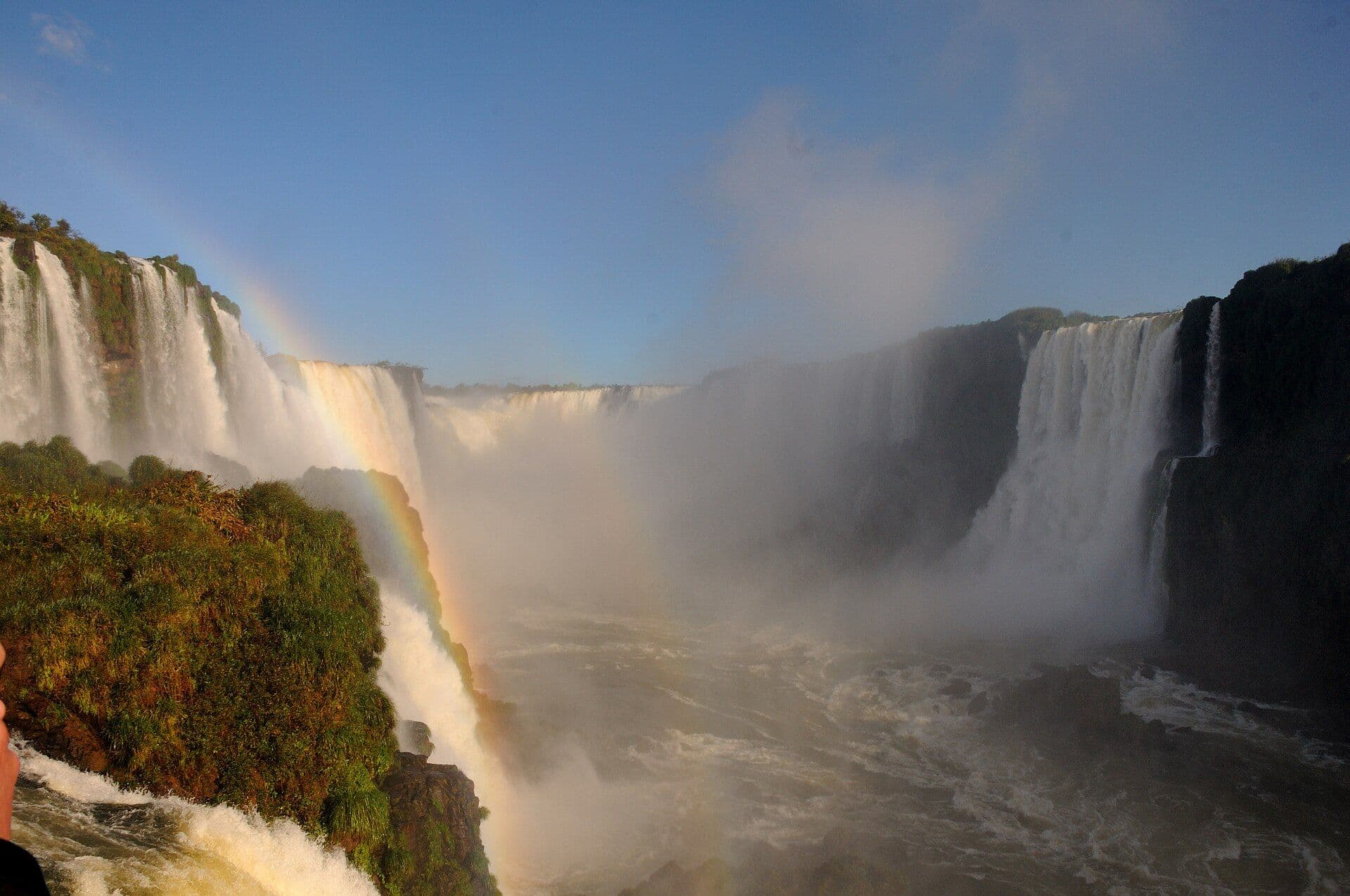
On the border between Argentina and Brazil, the Iguazú River reaches the edge of a plateau and breaks into hundreds of waterfalls. The roar can be heard long before the water is seen. The people of Misiones explain the falls with a story of love and punishment, and its earliest written version has a narrator with a name: an old man called Yarú.
Great water
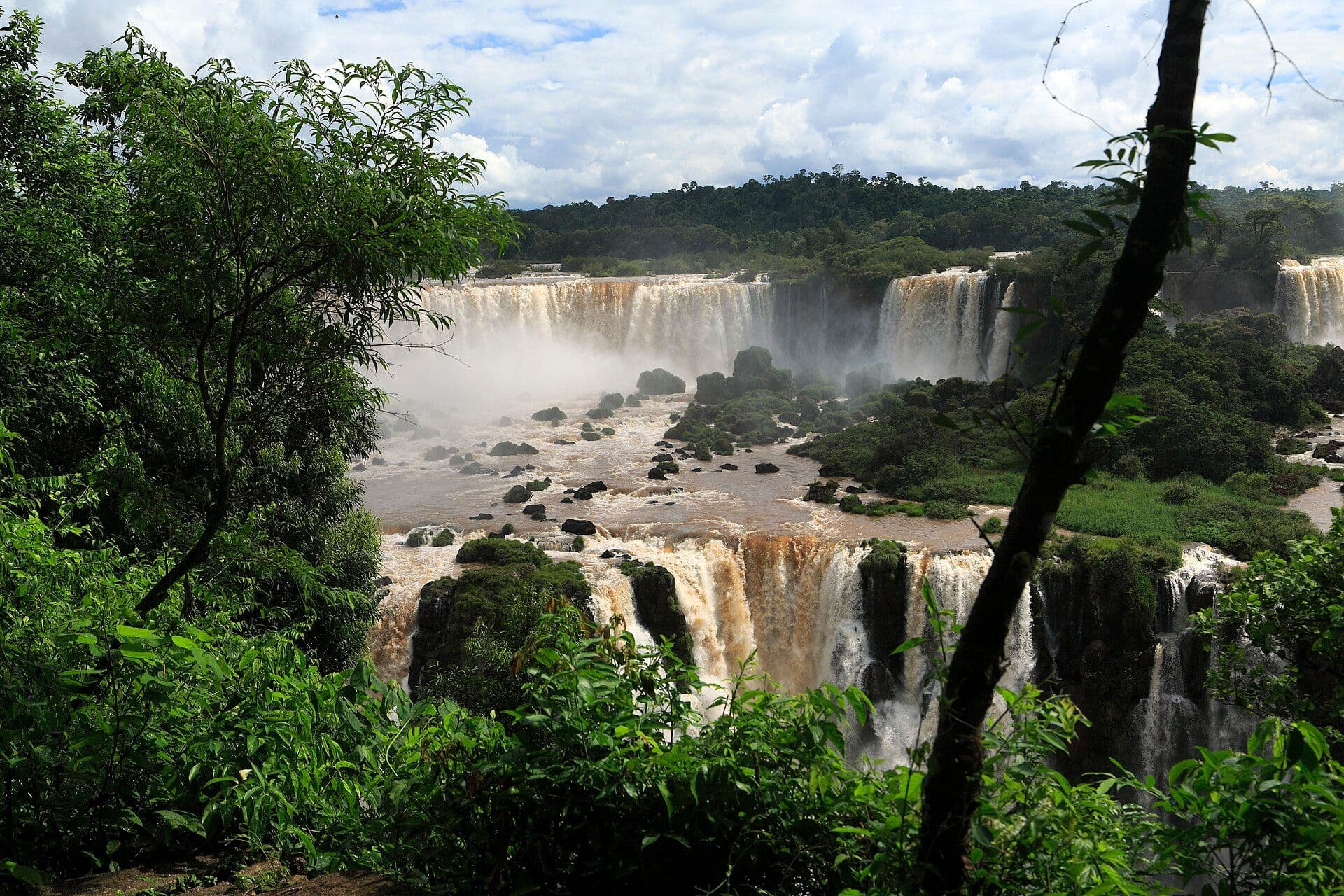
The Iguazú River flows west across southern Brazil and, just before joining the Paraná, drops off the edge of a basalt plateau. The result is a front of waterfalls nearly three kilometres wide, split by islands into some 275 separate falls. The largest, a horseshoe-shaped chasm known as the Devil’s Throat, carries the main flow of the river and marks the border between the two countries.
Both sides are protected as national parks surrounded by Atlantic rainforest, home to toucans, coatis and hundreds of species of butterflies.
The legend told by Yarú
In 1901 the writer Florencio de Basaldúa published an account of an expedition to the falls. In it he wrote down a legend told beside the great cataract by Yarú, an old Indigenous man who worked for the expedition, “just as his parents used to tell it”.
A god in the shape of a serpent ruled the world. It lived in the temple of Mboí, the great shaman, whose daughter Naipir was the most beautiful of all. The serpent wanted her for itself, and she was consecrated and shut away in the temple. But Naipir loved Carobá, a young warrior and chief of his tribe. On the night of the consecration, while the shamans and chiefs feasted, he carried her off in a canoe down the river.
The serpent heard the paddle striking the water. In its fury it tightened the coils of its body beneath the earth, and the earth split open: that is how the falls were born. Naipir became a rock heated by an underground fire, over which the water leaps forever; Carobá became a tree on the edge of the abyss, beside his broken canoe, condemned to watch her without ever reaching her. And the serpent, says the story, still lies in wait in a cave beside the falls.
Who told the story?
The legend is usually presented as Guaraní, the people whose language gave the river its name. Basaldúa’s text, however, makes Carobá the chief of a Kaingang tribe, another Indigenous people of the region, and the story may combine traditions from different groups. As with many legends written down by travellers, we only have one man’s memory, filtered through a writer’s pen.
Plan your visit
Practical notes for travelling there. Conditions, schedules and prices change: check before you go.
- Base town
- Puerto Iguazú (Argentina) · Foz do Iguaçu (Brazil)
- Best time to go
- The falls can be visited all year. Water volume changes with the rains upstream; spring and autumn offer milder heat than summer.
- Getting there
- Both towns have airports with domestic flights (Puerto Iguazú from Buenos Aires; Foz do Iguaçu from São Paulo and Rio). The Argentine side has walkways among the falls and a train to the Devil’s Throat; the Brazilian side has the great panoramic view. Most visitors see both, crossing the border by road.
Good to know
- You will get wet near the Devil’s Throat: protect phones and cameras.
- Do not feed the coatis; they bite.
- Carry your passport to visit both sides.
- Plan at least one full day for each side.
Related stories

Nature & Geography·Argentina
Patagonia: Elal, the hero who arrived at El Chaltén on a swan
The Tehuelche say their creator hero crossed the sea on a swan and landed on the summit of Fitz Roy. From there he spread life across Patagonia.
Peoples & Communities·Argentina
Tierra del Fuego: the Hain, the secret of the Selk’nam
At the end of the world, Selk’nam men painted their bodies and became spirits. It all began, they said, with a lie told by the women and a fight between the Sun and the Moon.
Culture & Traditions·Argentina
Quebrada de Humahuaca: feeding the Pachamama
Every 1 August, in northern Argentina, a hole is opened in the ground to feed Mother Earth. It is a living rite.